On the third day of the war, Bheeshma chooses the eagle formation and stations himself at the beak. Pandavas answer with a half moon formation! Initially Arjuna has the upper hand and the kauravas retreat. Duryodhana, upset approaches Bheeshma and criticises him, 'Grandfather, being partial to pandavas, you and drona are not fighting enough considering your abilities.' This angers Bheeshma 'Hey! I told you a number of times, for your own good, that pandavas are unbeatable! That is the truth! I am doing as best as I can as an old man!' But stung by the remark he stands firm and manages to scatter the pandava army. Arjuna confronts his grandfather but is unable to shake him. Bheeshma continues to shower arrows and pick the pandava soldiers at will and kill them.
Krishna sees this and thinks that Arjuna, forgetting his duty is acting soft in spite of loosing so many of his men, decides to kill Bheeshma and reduce the burden on pandavas. He walks towards Bheeshma with his chakra in readiness. Bheeshma seeing this, welcomes him, 'It is an honor to be defeated by you. If you kill me I am ensured of a place beyond'. Arjuna jumps out of the chariot, tries to stop Krishna by holding his arms, but Krishna does not stop and drags him along like a Storm dragging the trees in its path. Then Arjuna holds on to Krishna's legs, but is not able to stop him for another ten steps. Finally Krishna stops and Arjuna pleads with him, 'Do not be angry Krishna! If you forsake us, who is there for us! I take a vow in the name of my brothers and children. I will not hold back. I will destroy the kauravs'. Krishna is satisfied with this promise and returns to the chariot still holding his weapon is readiness. He blows on his conch 'Panchajanya'. There is an immediate difference in Arjuna and his arrows fill the air in all directions and the day belongs to Arjuna. As Bheeshma, Drona, Duryodhana and others retreat unable to face this barrage of arrows, the sun sets and the war is stopped.
Monday, 30 April 2012


Sunday, 29 April 2012
The war! Mahabharata 137
After his dialogue with Krishna, Arjuna is ready to fight. Yudhisthira meets Bheeshma, Drona and other gurus and receives their blessings and is praised by all the rajas for his devotion and concern for elders and is now prepared.
There is again a small variation in detail between versions.
Yudhisthira walks towards Bheeshma, does not explain to his confused brothers the reason why, and the enemy army becomes quiet and watchful. They think Yudhisthira is approaching Bheeshma to surrender! He falls at Bheeshma's feet and seeks permission 'Grand father, I am waging a war against you! Please permit me and bless me!' Bheeshma is happy, 'Yudhisthira, I am glad you came, if not, you would have been cursed and would have lost the war. I permit you to fight. Fight and be victorious. You can ask me anything, but do not ask me to stop the war. I am obliged to fight the war along with kauravas, but you are assured of victory!'
In the same manner, Yudhisthira prostrates before Drona and is blessed by his guru. Drona says 'I give you permission, with Krishna as your mantri, your victory is assured.' Dharmaraja has one question, 'Acharya, how do we win against you?' Drona reponds, 'As long as I am fighting you have no hope of a victory! So you and your brothers must plan to kill me very quickly'.
Yudhisthira then asks, 'Acharya then please tell me the way we can do this, I beg you to tell me with folded hands!' Drona suggests, 'I do not think anyone can kill me while I am fighting. The only way is to kill me when I drop my weapons and sit still. For me to give up my weapons in a war, I should hear a very unpleasant news from someone I totally trust.' Yudhisthira also meets Kripa and Shalya and gets thier blessings and permission. Shalya remembers the promise he had given Yudhisthira and tells him that he will try to demoralise Karna as promised....
To signal the beginning of the war, conches are sounded and drum are beat. Dussasana begins the attack as Bheeshma leads them from the front. Pandavas counter attack with Bheema in the lead. They fight relentlessly, forgetting relationships and earlier friendships. By afternoon Uttara is killed while in combat with Shalya. Bheeshma radiant like the afternoon sun, showers arrows continuously without stopping from his bow. Pandavas' army scatters unable to face this incessant stream of arrows. They scream in pain and distress. By that time, the sun sets and it becomes dark and the combat is stopped due to lack of visibility.
The second day, the combat begins again in the morning, Dhristadyumna sets the formation of 'Krauncha' a heron and installs Arjuna as its leader in front. Arjuna engages Bheeshma, Dhirstadyumna attacks Drona and Bheema kills the king of Kalinga. As kaurava army withdraws with exhaustion by evening, the second day of war ends.
Friday, 27 April 2012
Different aspects of Vishwaroopa. Mahabharata 136
While vachana bharata has just couple of words to describe Vishwaroopa, Kamala's version has more.
Arjuna says: 'I desire to see your divine form, if you think I am fit enough to behold it.' Krishna grants him divine eyes and reveals his divine form. Like the splendour of a thousand suns, the splendour of the mighty one was seen by Arjuna. He beheld the entire universe with all its myriad manifestations all gathered together in one. Arjuna salutes with pressed palms and says, "Lord of lords! In thy body I see all the gods and all the varied hosts of beings as well. I see brahma and all the rishis. You are infinite in form. There is no beginning or middle or end. You are a glowing mass of light. You are the imperishable, the supreme that has to be realised. You are the home for the entire universe. You are the guardian of the entire law. You are the primal being. Your eyes are the sun and moon, and your face is glowing with the radiance of fire, this universe is being devoured by the fire that is you. By the thee are filled the inter-spaces of heaven and earth and the sky. Looking at you the world trembles and so do I'. ......
Vishwaroopa darshana being dealt with just a couple of words in vachana bharata is not surprising. The vachana focuses on the story. While the concept of Atma is implicit, awareness of the world around you is intrinsic. We have a 'darshana' every moment of our life. What we make out of it is dependent on so many factors. While the sky is more or less the same, earth below has changed dramatically since Mahabharata times.
We see more of the universe now thanks to science and technology. We even have the power, thanks to the nuclear bombs, to wreak havoc on earth, equaling the devastation wrought by the angry gods. What the rishis could imagine or see with their special vision and intelligence is now partly available to many, thanks to the pictures from the hubble telescope or a highly powerful microscope. It is not that the scientist can explain everything about the universe with the certitude of a rishi, but we know that it is larger than we ever thought, more complex and certainly more confusing! At the same time, there are multitudes of us, who are still limited to the vision of the vishwaroopa darshan that sage vysasa described and are impressed and content. A lot more have no clue to either of the versions, either of the rishis or of the technology !
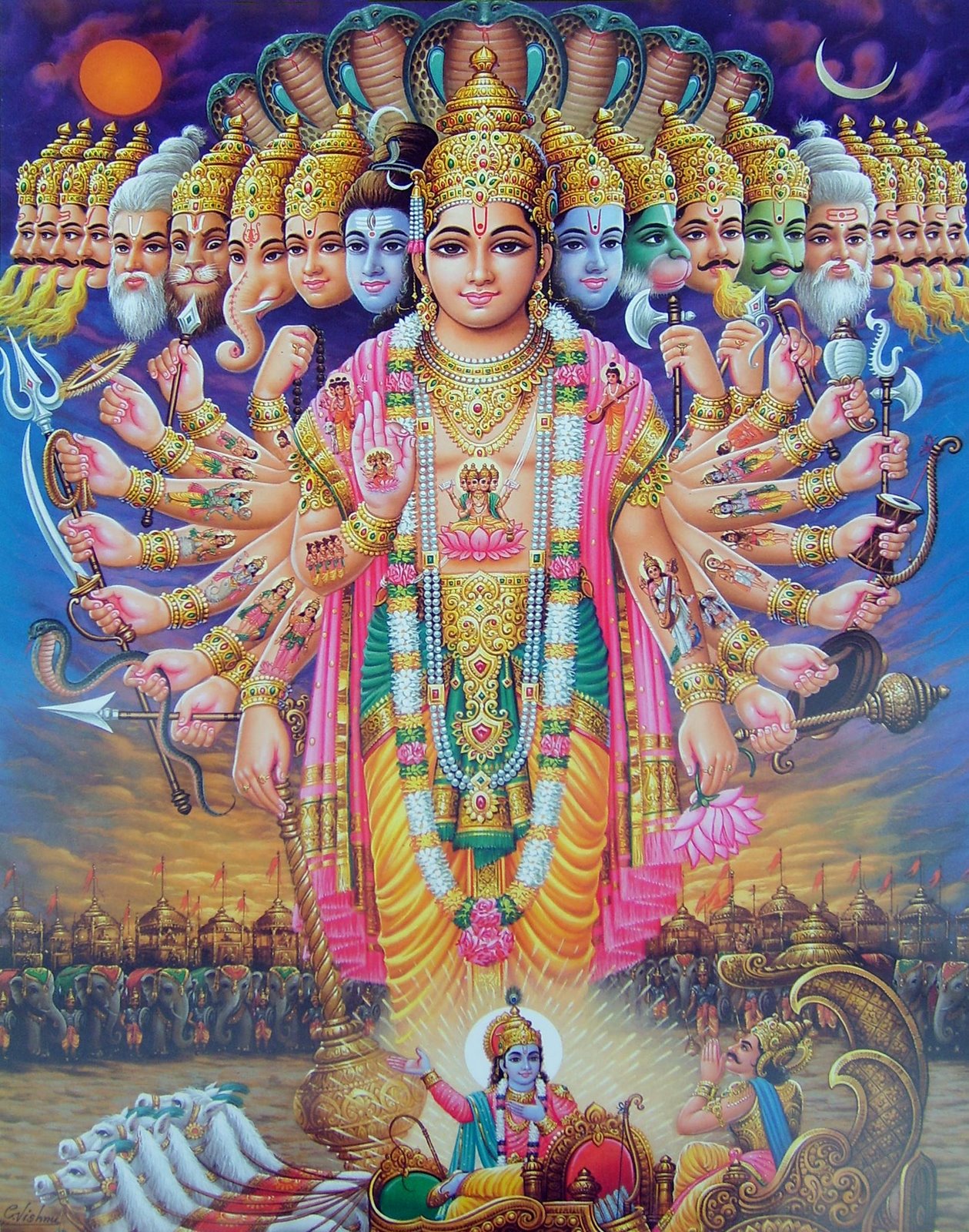 |
| Vishwaroopa that Arjuna was shown by Krishna |
 |
| Today we know the age of the Universe to a much higher precision than before Hubble: around 13.7 billion years. |
 |
| head of a human flea |
Wednesday, 25 April 2012
Bhagavad Gita in brief, as in Vachana Bharata. Mahabharata 135
Krishna looks at the teary eyed Arjuna and asks with a laugh 'What happened Arjuna? You appear to talk intelligently, but you express grief for those who do not deserve to be grieved. Those who know, will neither grieve for the dead nor those who are yet to die. You, I and all the kings were existing earlier and will continue to exist in the future. Even if the body falls the atma will continue to exist. As long as this body is alive it passes through the stages of childhood, youth and old age and it passes on ... and then again gains a new body. As we throw our old clothes and wear new ones. Similarly atma leaves old bodies and enters a new one. Which weapon can destroy the atma? In addition, those born must die. Also war is a khsatriya dharma. It is an open door to heaven for the war heroes. If you do not fight, you forsake your dharma and it is a sin. Also your enemies will speak ill of you. For an honourable man, a bad name is worse than death. So do what is required to be done, regardless of the results. One who works with committment is never unhappy, his mind is steady and he will have peace. Without peace will there be happiness?'
'Action is much superior to inaction! Do you believe that sitting quiet is inaction? No one can avoid action even for a split second. Nature ensures that there is constant action. Even the very learned are under its control. Can you stop its functioning? To think you can ,is just your ego. You are a khsatriya; rushing eagerly to fight is the true nature of your caste. If you think otherwise it is due to your ignorance. Bound by your nature and your karma, you have to do what you are required to do. It is now the time for destruction. All those here are bound to die, whether you are here or not. We can even say that they are already dead. Look at vishwaroopa, you can see it for yourself.'
'Renunciation is not just avoiding work. Doing your work devoid of expectations is sanyasa. Working without aiming at rewards is sanyasa. You should not give up work that is ordained. Ishwara sits in everyone's heart turns everything around like a machine. Have faith and leave it to him. You will have peace of mind. Anyway it is now left you. Do what you think is right!'
The terse pep talk by Krishna is closer to my understanding of what is needed to overcome the last minute nervousness of a warrior.
Tuesday, 24 April 2012
Arjuna does not want to kill his kinsmen. Mahabharata 134
Raghu would say, almost challenge, I am waiting to see how you deal with Krishna's 'Gitopadesha!'
It is not difficult as Vachana Bharata, the version I follow, has dealt with it very briefly.
My questions were, once I learnt that Gita was originally enunciated by Krishna on the first day of the great war, how long did it take him to reveal this gem of hindu philosophy, called the Upanishad of Upanishads? Did Arjuna really grasp it one hearing? Most would dismiss it as irrelevant questions and a few would claim that it all happened in the blink of an eye and tell me both 'Krishna and Arjuna were not just ordinary humans'. Anyway it was lucky for us that Sanjaya heard and Vyasa divined Bhagavad Gita and included it in Mahabharata.
Before I get back to the Vachana Bharata there are a few nuggets from Kamala's version:
The warriors on either side met and set the rules of the war: The fight should be between equals, two archers, two charioteers and so on. If during the fight if one withdrew he should not be harassed. If one fought with words, he should not be attacked with arrows! Anyone who runs away should not be killed. Charioteers, animals and servants who blow the trumpet or beat the drums should not be attacked.
The night before the war, Vyasa meets Dhritharashtra and offers him eyesight if he wants to see the war and Dhritharashtra declines the offer as he does not want to see his sons die. He would be satisfied if he could hear about it. So Vyasa gifts Sanjaya with ability to see everything that happens in the war. Hear their spoken words and even know their thoughts. 'He will see the battle in the day and relate it to you in the night. He will know no fatigue and exhaustion.' He tells Dhritarashtra that the omens prophesies the death of kauravas and the victory of pandavas, comforts his unhappy son and leaves.
... Yudhisthira sheds his armour and drops his weapons and goes barefoot towards kauravas. Perplexed his brothers follow him. Yudhisthira approaches Bheeshma and seeks his blessings as war is now about to begin. Bheeshma is pleased to bless him and says that the pandavas are assured of a victory. Yudhisthira then goes to his gurus Drona, Kripa and Salya and is blessed by them as well.
Meanwhile Krishna goes to Radheya with an offer that as he is not fighting along with Bheeshma, he could join pandavas, at least till Bheeshma is killed and then join Duryodhana again. Radheya laughs and requests Krishna to let him meet his fate with the kauravas. Krishna leaves saddened at the thought that Karna, a great hero, would die in a few days.
Then Yuyutsu one of the brothers of Duryodhana seeks to join pandavas and Yudhisthira welcomes him with the words that there will be at least one son from Kauravas who would perform rites when Dhritarashtra dies. These words spreads gloom amogst the kauravas.
To continue with Vachana Bharata:
Krishna moves the chariot to the centre of Kurukhsetra and Arjuna looks around and spots his grandfather, uncles, cousins and his gurus. Looking at them his heart melts. 'Krishna is it really right to kill my own relatives for the sake of the kingdom? I do not want it. I will not fight even if I am offered the three worlds. There is no fun in killing your own kin. They are without sense and are greedy and are ready to fight even if it means the destruction of our clan. Should we be like them? It is a great sin! It is better to live as a beggar than acquire wealth by killing your own elders and teachers. It is better that kauravs kill me!' Full of sadness, Arjuna then drops his weapons and sits still!.
Monday, 23 April 2012
Bheeshma parva. Mahabharata 133
The day before the war Duryodhana talks to his commanders about the need to protect Bheeshma and ensure that he is not killed, as he alone is capable of destroying the pandava army. They must aim to kill Shikandi as Bheeshma will not fight him. Accordingly the next day, as Bheeshma leads the army, he is surrounded by many valiant warriors in chariots who are not afraid of death, hundreds of thousands of soldiers and a large army of elephants to protect him.
Pandavas with a smaller army adopt a diamond formation and are lead by Dhristadhyumna along with Bheema, Nakula and Sahadeva. While Arjuna concentrates on protecting Bheeshma's enemy Shikandi.
Early in the morning as the armies face the sun and offer prayers to Surya, a loud thunder is heard and there is lightening, even though the sky is cloudless. There is a strong wind; hailstorm; dust rises and it becomes dark. The earth shakes and cracks appear. As a dull sun appears over the horizon, a screeching meteor strikes the rising sun.
Duryodhana looks at the pandava sena in formation and worried, goes to Dronacharya and requests, 'Acharya, we have with us, like you, many brave men ready to die, even then I feel we do not have enough strength. Please take extra care to protect Bheeshma.'
Soon Bheeshma's conch is heard and the other warriors blow on their own conch. In reply pandavas, Arjuna and Krishna sound theirs. The sound fills the sky and creates a tremor in kauravs heart. Arjuna expresss a wish to see both the armies and Krishna brings the chariot to the center.
Saturday, 21 April 2012
As the warring factions try to sleep the night before the war! Mahabharata 132
I have no idea how the pandavas or the kauravs spent the night before the war or for that matter the hundreds of thousands of recruited foot soldiers and the volunteers. I do remember reading in one of the chapters of Ramayana that the soldiers would get restless if they were kept idle for too long. That was in treta yuga, and it could be the same in dwapara yuga and I suppose we can ask our army friends whether it is still true in kali yuga! But, I am sure the arms makers will surely be desperate if there is peace on earth for too long.
I began with some questions; 'Why are we so oversensitive? Is it part of our psyche? Do our great epics teach us how to conduct ourselves? How relevant are they today? .....and the answers have to wait!
The story, by itself is strange. Whether it is Ganga throwing her children into the river or Satyavathi having a child by sage Parashara and blessed to be a Virgin again. The plight of Kunti and the boons given her by an (irresponsible?) rishi Durvasa. The birth of Draupadi. The direct interaction between mortals and gods, apsaras and the rakshas. The constant visits by Vyasa and Narada, all need explanations which test ones' rational approach to events.
My own approach which began with an incredulous and sarcastic note has seen many changes. I have taken many detours. My basic approach has been of one, who has only heard the stories in bits and is now trying read it in full. In fact, we may at the end of this blog discover what an untutored, an anpad, will make out of this epic story!
We have numerous examples of the many beliefs that persist. As I walk around, I discover temples dedicated to the diverse manifestations of goddess shakti. One takes care of all the summer ailments. Another, you should see the queue in the mornings, where children with diaherria are brought to be blessed. I am told that they prefer to go there instead of getting medicines from doctors!'
I have a picked a few comments made in my blogs which illustrates that the answers are not easy.
" wonder if this type of analysis is valid in this age. However, parallels can be seen demonstrating that human nature has not changed but the milieu has.. ..
That was Dwapara Yuga when the hotline between the gods and man was still operating, albeit after 'ghor tapasya'. In Kali Yuga it has been replaced by power lines that connect only mortals. Therefore only 'nasmarana' is effective! But cannot elicit boons ..
Single women wanting to have children is common in Western societies. I read an article about chat groups formed by offspring of a single sperm donor. So the craving for offspring i.e. progressers of lineage is not too strange. Kerala provided a modern example in India! Lysenko postulated the influence of environment on the outcome of pregnancy. Derided outside Soviet Union but may have an iota of truth! ...Raghunath"
'Why are we so oversensitive?' The question itself needs to be rephrased. While I try hard at my age to avoid becoming oversensitive, I see that it is mostly a political act! True most of us, the aam admi, are just long suffering Mr. Citizens! Those in power and those who are influential, barring a few exceptions are just overbearing! My friend chandramouli calls them Rakshas. Mahabharata tells us that they could be the new khsatriyas. In fact, many are classified as khsatriyas.
Subscribe to:
Posts (Atom)